- IndustriousAF
- Posts
- July 21, 2025: ShopTalk Monthly Brief on AI × Workforce × Industry
July 21, 2025: ShopTalk Monthly Brief on AI × Workforce × Industry
Real-world signals from machines, makers, and lawmakers.

IndustriousAF -
August 01, 2025

What is IndustriousAF? A lean nonprofit pairing tech with hands-on talent. We pilot AI-powered apprenticeships, spotlight the sharpest takes from factory floors, labs, and policy circles, and convene the people who turn tools into jobs.
ShopTalk. Every month we sift the noise and surface the signals on AI and work. From boardrooms to shop floors, see what builders, lawmakers, and line operators are really saying about the future of jobs. Skim the receipts, judge the reality. Tell us what you think. Let’s dive in →
💻 Form Tech
Tweets, clips, and takes from the builders and investors pushing AI into everyday tools and products.
The gap between what AI can do vs what we're building with it is MASSIVE right now. That gap is your opportunity to build.
This might be the best time ever to start an AI company.— Garry Tan (@garrytan)
6:14 PM • Jun 25, 2025
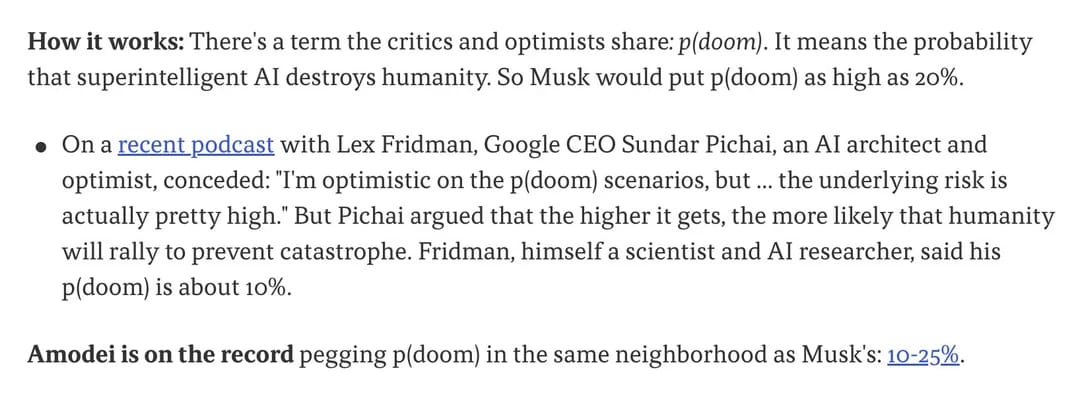
Google CEO says the risk of AI causing human extinction is "actually pretty high", but is an optimist because he thinks humanity will rally to prevent catastrophe (Source: Reddit)
Dylan Patel says “the word AGI has no meaning anymore.” The real race is for superintelligence and the people who can build it.
Ilya saw it first. So he started Safe Superintelligence Inc. (SSI).
Zuck tried to acquire it. He also made moves on Thinking Machines and
— vitrupo (@vitrupo)
4:28 PM • Jul 1, 2025
We asked @dwarkesh_sp to share his disagreements with @tylercowen on AGI:
"He believes AGI is here."
"But then he also believes AGI is going to result in 0.5% more economic growth a year."
"When AGI hits, we're going to see, like, 20% economic growth as a minimum."
"Our
— TBPN (@tbpn)
8:44 PM • Jul 7, 2025
Musk on AGI:
"Will this be bad or good for humanity? I think it'll be good. Most likely it'll be good. But I've somewhat reconciled myself to the fact that even if it wasn't gonna be good, I'd at least like to be alive to see it happen."
(Followed by awkward silence)
— Billy Perrigo (@billyperrigo)
2:57 PM • Jul 10, 2025
agree with lots of what jensen has been saying about ai and jobs; there is a ton of stuff to do in the world.
people will
1) do a lot more than they could do before; ability and expectation will both go up
2) still care very much about other people and what they do
3) still be— Sam Altman (@sama)
5:49 PM • Jul 16, 2025
🏛️ From Policy
Statements and sound bites from the officials and wonks steering how AI meets jobs, wages, and national strategy.
Burgum: "AI will take jobs away, like software development, because AI can write code. But AI can't wire a building, do plumbing. Kids go into the trades today -- they're all gonna be making $150,000."
— Aaron Rupar (@atrupar)
10:54 PM • Jul 15, 2025
That raises the likelihood that soon, the number one leadership challenge for world leaders, including the President of the United States, will be to manage the changes that AI is bringing about, and to use the visibility of office and the tools of policy to ensure that this technology makes people better off and not worse off.
What’s behind this hands-off approach is a staunch belief in free market capitalism to maximize growth and social good. I strongly believe in capitalism and free markets. But we’ve seen the catastrophic downside of unfettered profit seeking. Just ask the families of the more than 800,000 Americans who have died from the opioid epidemic because the Food and Drug Administration didn’t do its regulatory job and stop a company’s reckless desire for profit.
That is an extreme example, and in the case of AI, there is no doubt that recent innovations are going to do incredible things for humanity. But even as we celebrate technological progress, we should pause to consider the societal cost of these new tools.
Mike Rowe: “We’ve been telling kids for 15 years to learn to code.”
“Well, AI is coming for the coders.”
“It’s not coming for the welders, the plumbers, the steamfitters, the pipefitters, the HVAC, or the electricians.”
“In Aspen, I sat and listened to Larry Fink say we need
— Holden Culotta (@Holden_Culotta)
6:05 PM • Jul 16, 2025
⚙️ From the Manufacturing Floor
On-the-ground signals from plants and job sites—new hires, fresh tooling, and worker chatter you will not see on social media.

With the largest community of van and truck workers in North America, Ford Pro customers are the beating heart of the Essential Economy. When I talk to our customers, I hear firsthand about the challenges they face, from permitting problems to being unable to find enough workers. In fact, our country is short 600,000 factory workers and 500,000 construction workers right now. We need 400,000 auto techs over the next three years.


Researchers from Stanford created a first-of-its-kind database (WORKBank) by surveying 1,500 workers and 52 AI experts across 104 occupations to assess which tasks should be automated or augmented by AI agents. They found that workers are eager to automate repetitive, low-value tasks but overwhelmingly prefer AI to augment—not replace—human work, particularly in tasks requiring interpersonal skills. The study reveals that current AI investments and research are misaligned with worker preferences, underscoring a need for human-centered AI development. source
